
Can You Refuse a Breathalyzer Test After a DUI Stop in California?
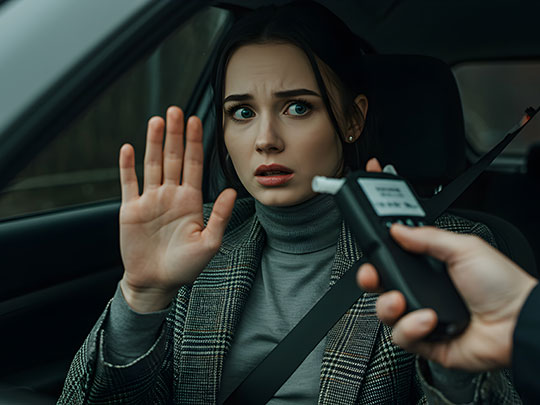
Can you refuse a preliminary alcohol screening without making a DUI stop worse? If you’re searching “refuse breathalyzer California” online, the answer is yes, but there are penalties.
California is an implied consent law state. That means by simply driving in California, you automatically consent to breath, blood, or urine testing after a lawful DUI arrest. While you can generally decline field sobriety tests, a chemical test refusal during a DUI stop can have serious consequences like a DUI license suspension, with or without a conviction.
If you’re considering whether to take a breath test, you need to understand the testing requirements, penalties for refusing, and your rights as a driver.
Roadside Test vs Post-Arrest Test
There are two general types of tests law enforcement performs: field sobriety tests and chemical (blood and/or breath) tests.
When pulled over for a suspected DUI, officers will first request field sobriety tests like a walk-and-turn, one-leg stand, or eye tests. An officer may also use a handheld PAS device to obtain a roadside breath test. This helps determine whether you’ve consumed alcohol, and if so, how much.
Field sobriety tests are designed to gather “probable cause” for an officer to make a DUI arrest. While both tests are voluntary if you’re over 21 and not on probation, your test results could still be used against you in court.
DUI probation and under 21 rules are stricter, however. Drivers can lose their license for refusing a lawfully requested breath test, and may be charged with a new DUI and a Probation Violation (VOP) proceeding.
After an Arrest
A post-arrest chemical test, or sobriety test, is mandatory under implied consent laws after a lawful arrest. These blood tests measure the exact Blood Alcohol Concentration (BAC) or detect drugs for criminal prosecution. By determining a driver’s blood alcohol concentration, law enforcement can figure out if a driver is illegally driving while intoxicated.
An officer may also require a blood or urine sample if they suspect you’re under the influence of drugs or alcohol. Sobriety tests are fully admissible in court as direct evidence of your BAC or intoxication level.
Exceptions to the Rule
California’s implied consent laws are strict, but a few exceptions exist. Those include medical conditions like a respiratory disorder that prevents you from taking a breath test, or neurological disorders like Parkinson’s that impair motor skills, coordination, speech.
In those cases, you may be able to avoid refusal penalties, but you’ll likely be asked to take a blood or urine test instead.
Other exceptions include if the arresting officer stopped you without reasonable cause or failed to follow protocol. Your attorney might challenge refusal penalties in court, arguing the stop itself was unlawful. In some cases, a driver may refuse a test to require law enforcement to obtain a warrant first. In theory, this gives a driver time to “sober up,” and may prevent their arrest.
What Refusing Does to Your License and Your Case
Refusing a breathalyzer test can hurt your case in court. Prosecutors often argue that a refusal is evidence of guilt or that a person knew they were intoxicated. It can also limit your attorney’s ability to negotiate for lesser charges or plea bargains. Courts may treat breathalyzer cases harshly if they view your refusal as interfering with police or a threat to public safety.
Penalties
There are two separate types of California penalties: administrative and criminal. Administrative penalties are enforced by the DMV and do not require a DUI conviction.
When you refuse a test after arrest, the DMV suspends your license. A first refusal carries a one-year license suspension. However, if you have prior DUI convictions within the past 10 years, a refusal can result in a two or three-year license suspension.
You can request a DMV hearing to challenge your suspension, but you must do so within 10 days of receiving notice.
However, if you’re charged with a DUI, the court may impose an additional refusal penalty enhancement. Criminal penalties may include longer jail time, harsher fines, and mandatory DUI education programs.
Has a refusal or a search warrant blood draw led to your DUI arrest? When your license and freedom is at stake, you need a DUI defense Orange County residents can count on. Contact Stein Defense right now for a free consultation to discuss your next steps.